
What Is Energy Management Software (EMS) and How Do You Choose the Right Solution?
Energy Management Software (EMS) is now one of the most strategic tools for any organization looking to manage and optimize its energy consumption. According to ADEME, companies that implement structured energy monitoring can reduce their energy bills by an average of 10 to 20%. However, achieving these results requires choosing the right solution and deploying it effectively.
In this guide, Ubigreen explains what Energy Management Software is, what it is used for, how it works, and which criteria you should consider when choosing a solution — particularly as part of an Energy Management System (EMS) or to meet regulatory requirements such as the French Tertiary Decree (Décret Tertiaire).
Download our Energy Management guide : 10 key steps
Today, energy management for your building portfolio relies on reliable, centralized, and effectively utilized data. This 10-step guide will help you implement an effective, data-driven strategy.
📊 Collection, analysis, and management: Discover how to use data to reduce your costs and improve your energy performance.
What Is Energy Management Software?
Energy Management Software, or EMS, is a digital solution designed to monitor, analyze and optimize the energy consumption of a building, property portfolio or industrial site.
It centralizes energy data within a single interface. This data can come from smart meters, IoT sensors, connected devices, utility bills or existing building systems such as BMS/BAS systems.
The objective is simple: to better understand how energy is used in order to identify inefficiencies, reduce consumption and manage energy performance over time.
💡 Unlike a simple Excel spreadsheet, Energy Management Software transforms raw data into actionable indicators, automated alerts and prioritized action plans.
What is the purpose of energy management software?
Energy management software is used to manage energy more precisely and continuously. By centralizing all energy flows—electricity, gas, water, and heat—it provides teams with a unified view of their performance.
In particular, EMS software allows you to:
- track electricity, gas, water, and heat consumption in real time;
- compare performance across multiple buildings or sites;
- automatically detect anomalies and excessive consumption;
- visualize consumption trends over time;
- prioritize and track energy efficiency initiatives;
- measure the savings achieved following renovations or optimization;
- facilitate regulatory reporting (Tertiary Sector Decree, BACS Decree) and CSR reporting.
Thanks to these features, EMS becomes a key tool for energy managers, real estate departments, sustainability teams, technical departments and finance departments.
Why Use Energy Management Software?
To better understand energy consumption
Before reducing energy consumption, you first need to understand where, when and how energy is being used.
Energy Management Software provides a clear and structured view of energy use, including energy-intensive equipment, consumption peaks and differences between comparable sites.
This visibility provides the essential foundation for any reliable energy strategy.
To detect anomalies in real time
Excessive consumption can go unnoticed for several weeks when monitoring relies solely on monthly utility bills.
With an energy monitoring platform, data can be analyzed continuously. Teams can therefore identify abnormal consumption much faster: heating operating outside occupancy hours, incorrectly configured equipment or unusually high nighttime consumption, for example.
To reduce energy costs
Energy can represent between 2 and 5% of revenue for industrial companies and up to 25% of operating costs for some local authorities.
By identifying energy losses and areas for improvement, Energy Management Software can directly contribute to reducing energy bills.
To manage an energy action plan
Beyond monitoring, effective energy management software should help teams track the actions they implement: setting objectives, measuring results and adjusting priorities.
This allows organizations to move from a reporting approach to continuous energy performance management.
How Does Energy Management Software Work?
Energy Management Software is based on four key steps.
1. Collect energy data
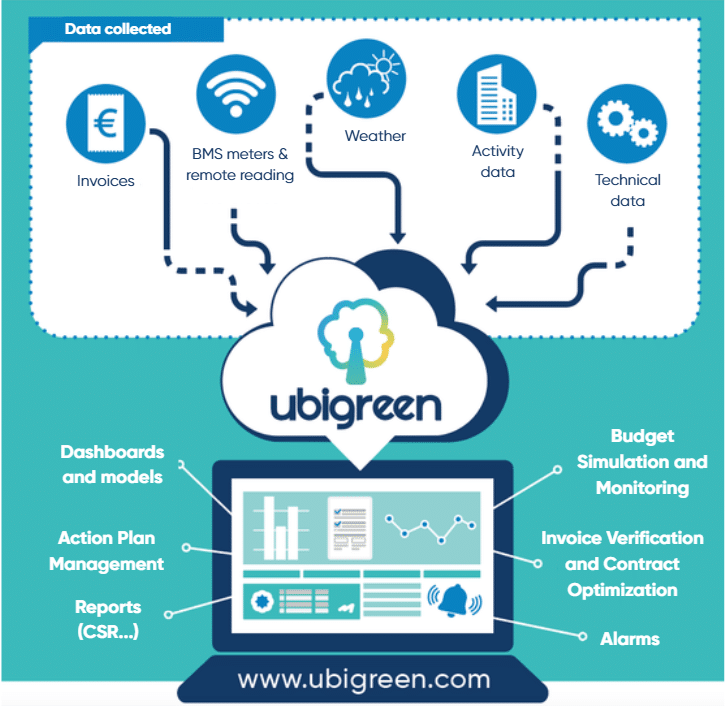
Data collection diagram – Ubigreen Energy solution
he first step is to collect consumption data from a wide range of sources: smart meters, IoT sensors, BMS/BAS systems, utility bills or imported files.
The reliability of this data directly determines the quality of the analysis that follows.
2. Centralize information
Data is consolidated within a single EMS platform.
This centralization makes it possible to monitor multiple buildings, sites or energy uses from one interface while eliminating scattered files and time-consuming manual analysis.
3. Analyze energy performance
The EMS transforms data into energy performance indicators (EnPIs): consumption per square meter, per use, per building, per period or according to a specific regulatory target.
These indicators can be customized according to the needs of each team.
4. Implement optimization actions
Finally, teams identify priorities and implement concrete actions: equipment adjustments, occupant awareness campaigns, preventive maintenance, renovation work, contract renegotiation or the monitoring of an Energy Performance Contract (EPC).
Energy Management Software and EnMS: What Is the Connection?
An EnMS, or Energy Management System, is a structured approach designed to continuously improve an organization’s energy performance.
The ISO 50001 standard provides the international framework for implementing, maintaining and improving such a system.
Energy Management Software is the operational tool that brings an EnMS to life on a day-to-day basis.
It provides the data, indicators and dashboards required to manage the process. It also facilitates objective tracking, action documentation and performance measurement — all essential elements of an ISO 50001 certification process.
📌 In short: the EnMS is the management approach, while Energy Management Software is the tool that supports its day-to-day implementation.
How Do You Choose Multi-Utility Energy Management Software? 10 Criteria to Compare
The best Energy Management Software is the solution that matches your use cases, organization and energy objectives.
Here are the key criteria to assess before making your choice.
Checklist: 10 Criteria for Choosing Energy Management Software
1. Automated meter reading and data collection
The software should be able to retrieve data from different sources: smart meters, submeters, IoT sensors, BMS/BAS systems, utility bills and imported files.
Points to check:
- compatibility with existing equipment;
- data collection frequency;
- available data granularity;
- ability to progressively add new meters.
2. Multi-utility consumption monitoring
An EMS platform should not be limited to electricity.
It should allow organizations to monitor water, gas, heat and different energy uses within a single interface.
Points to check:
- utilities supported;
- ability to compare utilities;
- visualization by use, building and period;
- consolidation of data within dashboards.
3. Metering data quality
The quality of the analysis directly depends on the reliability of the data collected.
Points to check:
- detection of missing or inconsistent data;
- historical data storage;
- anomaly correction;
- data traceability;
- reliability of performance indicators.
4. Multi-site energy management
For a property portfolio, the EMS should provide a consolidated view of energy performance while still allowing users to analyze individual buildings.
Points to check:
- site-to-site comparison;
- performance rankings;
- filters by building, area or property type;
- portfolio-level dashboards;
- different user access rights depending on teams and responsibilities.
5. Energy anomaly and overconsumption alerts
A good energy monitoring tool should make it possible to identify deviations quickly and initiate corrective actions.
Points to check:
- configurable alerts;
- customized thresholds;
- detection of nighttime consumption;
- automated notifications;
- monitoring of anomaly resolution.
6. Energy dashboards and reporting
Dashboards should be easy to understand, customizable and adapted to the requirements of different users.
Points to check:
- customizable indicators;
- role-specific views;
- data exports;
- automated reports;
- visualization of achieved savings;
- return on investment monitoring.
7. Integration with existing systems
Energy Management Software should integrate with the organization’s existing technical environment and tools.
Points to check:
- compatibility with BMS and BAS systems;
- available APIs;
- import and export capabilities;
- connectors with existing systems;
- scalability and integration possibilities.
8. Energy action plan monitoring
The objective is not simply to collect data. The software should help turn analysis into operational decisions.
Points to check:
- assignment of an action owner;
- deadlines;
- action status;
- expected savings;
- measured savings;
- decision history.
9. Regulatory reporting and compliance
Energy Management Software should facilitate the monitoring of regulatory requirements and continuous improvement initiatives.
Points to check:
- the French Tertiary Decree;
- OPERAT reporting;
- the French BACS Decree;
- ISO 50001;
- ESG indicators;
- Energy Performance Contracts.
10. Support and energy expertise
Software capabilities alone are not enough.
Initial configuration, user training and energy expertise are essential to ensure that organizations can make effective use of their data over the long term.
Points to check:
- deployment support;
- training;
- technical support;
- support with energy analysis;
- regular performance reviews.
What Is the Best Energy Monitoring Software?
The answer depends on your organization’s context.
- For a multi-site organization: choose a solution capable of centralizing data and providing consolidated dashboards across your entire property portfolio.
- For ISO 50001 or an Energy Management System: choose software that facilitates the monitoring of objectives, indicators and action plans.
- For regulatory requirements: make sure the solution supports requirements such as the French Tertiary Decree, BACS Decree or Energy Performance Contracts.
In short, the right Energy Management Software should be reliable, easy to use, scalable and backed by strong energy expertise.
Implementing an Energy Management System with Ubigreen Energy
When implementing an Energy Management System, Ubigreen Energy helps structure energy performance management around data, objectives and actions.
It supports organizations engaged in regulatory compliance initiatives — including the French Tertiary Decree and BACS Decree — as well as continuous improvement initiatives such as ISO 50001, ESG strategies and Energy Performance Contracts.
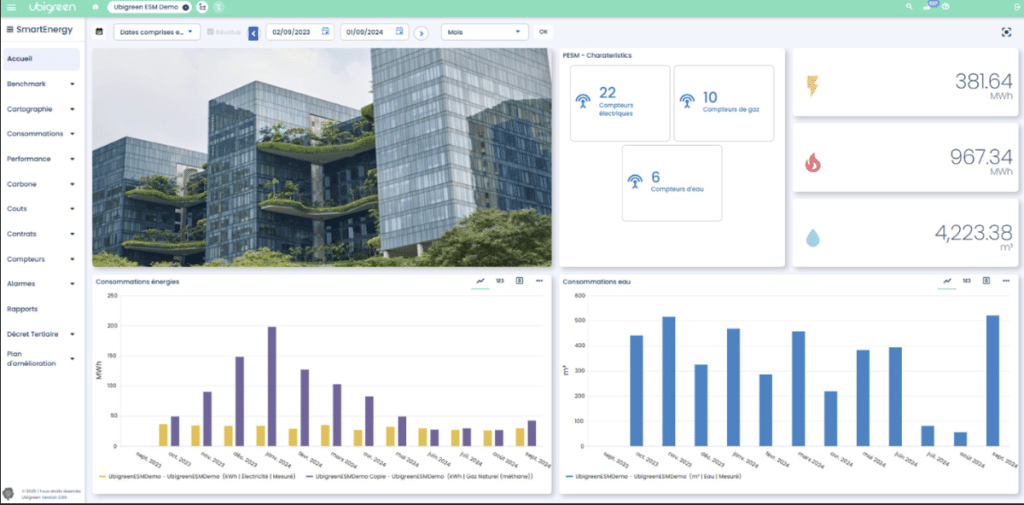
Home dashboard – Ubigreen Energy solution
A centralized view of energy performance
Ubigreen’s Energy Management Software consolidates all energy data within a single interface.
This centralized approach facilitates multi-site monitoring and provides teams with a clear, up-to-date and comparable overview of their energy performance.
Dashboards tailored to each role
Different users have different requirements:
- Technical managers need to detect energy anomalies quickly;
- Sustainability teams need consolidated indicators for reporting;
- Finance departments monitor costs, savings and the ROI of implemented actions.
With customizable dashboards, each user can access the information relevant to their role without being overloaded with unnecessary data.
Continuous action plan management
Implementing an Energy Management System does not end with the initial assessment.
Ubigreen’s EMS supports a continuous improvement approach by enabling teams to monitor objectives and related actions, measure their actual impact and adjust priorities over time.
Common Mistakes to Avoid When Implementing Energy Management Software
Deploying software without clear objectives
Energy Management Software should support a defined strategy.
Before deployment, define your objectives: reducing energy consumption, meeting regulatory requirements, implementing an Energy Management System or managing an investment plan.
Collecting too much data without using it
Data alone is not enough.
It is better to monitor useful and actionable indicators than to collect large amounts of data without a clear purpose.
Effective configuration helps transform data into decisions.
Neglecting user training
Energy Management Software is only effective when teams actually use it.
Training is essential to encourage adoption and maximize return on investment.
Failing to monitor actions over time
Energy performance depends on continuous improvement.
Without regular monitoring, savings can decline and inefficient practices may return. Schedule regular reviews of dashboards and performance indicators.
Why Is Energy Management Software a Strategic Tool for Energy Performance?
Energy Management Software is much more than an energy monitoring tool.
It is a management solution that helps organizations understand their energy consumption, identify anomalies, reduce costs and structure long-term energy performance.
As part of an Energy Management System, it becomes the operational foundation for monitoring objectives, documenting actions and embedding continuous energy improvement into the organization’s strategy.
With Ubigreen Energy, centralize your energy data, manage your action plans and move towards more efficient, compliant and sustainable energy management.