
Energy Management SaaS or On-Premise: Which Model Should You Choose?
Energy Management SaaS or On-Premise: Which Model Should You Choose for a Multi-Site Real Estate Portfolio?
Managing energy across a multi-site real estate portfolio requires much more than simply tracking bills.
You need to collect reliable data, centralize it, compare it, detect deviations, track action plans, and share the right metrics with the right teams. Real estate management, energy managers, maintenance, CSR, and IT—everyone needs a clear, actionable, and up-to-date overview.
When choosing a tool, one question often comes up: should you opt for a SaaS solution or an on-premises solution?
The choice isn’t purely technical. It affects deployment speed, maintenance, security, costs, collaboration among teams, and the ability to effectively manage a property portfolio over the long term.
So, Energy Management SaaS or on-premise: which model should you choose for a multi-site real estate portfolio?
SaaS or on-premises: What are we talking about?
SaaS software—short for Software as a Service—is accessible online via a web browser. It is hosted in the cloud and maintained by the solution’s provider.
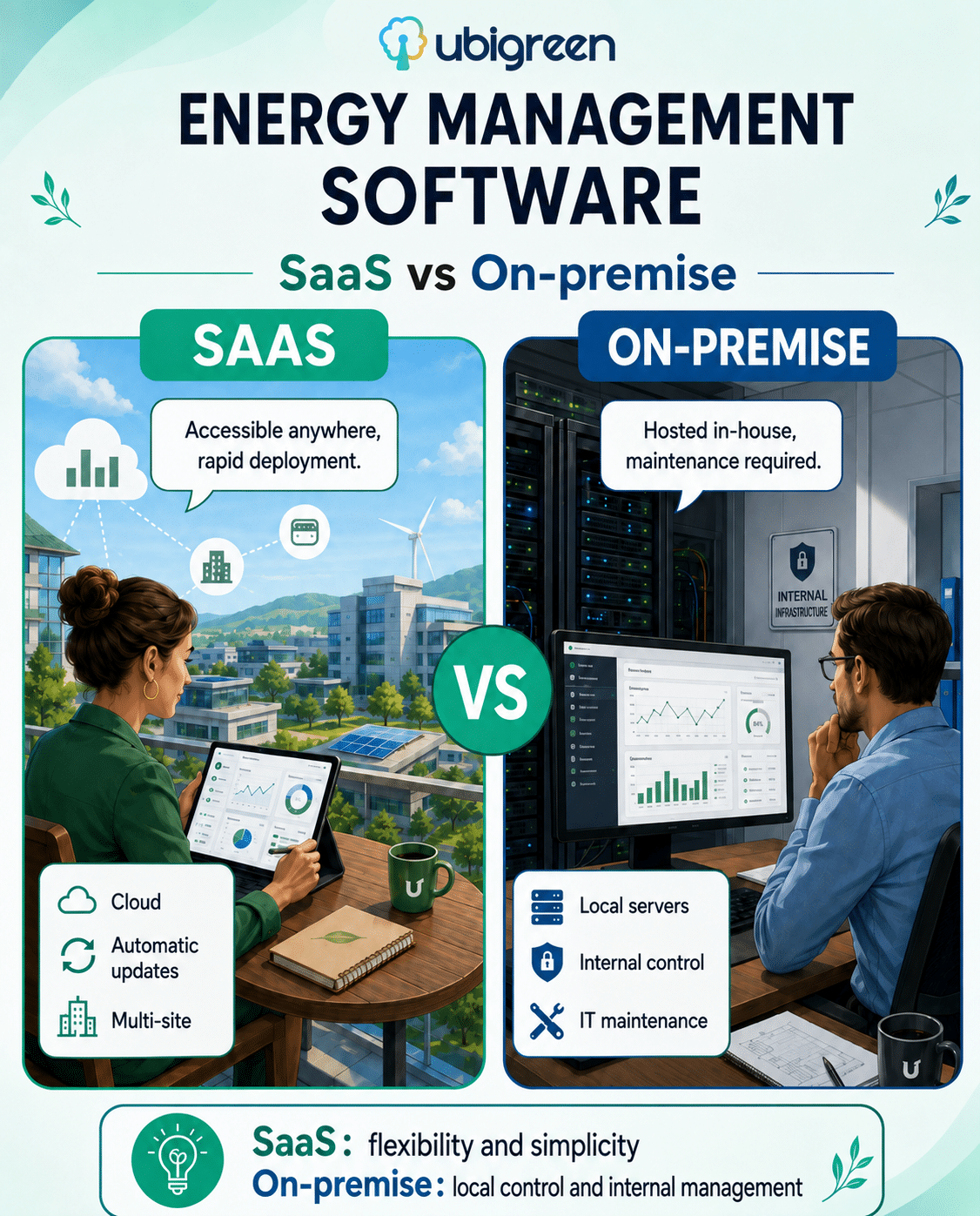
The company therefore does not need to install the software on its own servers. Updates, application maintenance, and functional enhancements are handled by the service provider.
In the context of energy management, this model allows a company to centralize energy data from its entire building portfolio on a single platform. This is particularly true of a solution like Ubigreen Energy, designed to manage multi-site, multi-utility consumption and support organizations’ energy goals.
Conversely, an on-premises solution is installed directly on the customer’s IT infrastructure. The company retains control over its technical environment but must also manage a larger portion of the installation, updates, maintenance, security, and service availability.
This model may be suitable for certain very specific contexts. However, for a real estate portfolio spread across multiple sites, it can quickly become more cumbersome to deploy and scale.
Why This Choice Is Important for a Multi-Site Real Estate Portfolio
Even for a single building, energy monitoring can be complex.
Across a multi-site portfolio, the challenges multiply: different data formats, a variety of meters, sites with varying levels of equipment, diverse usage patterns, multiple suppliers, and teams spread across several locations…
As a result, energy data is often scattered. It can be found in Excel files, supplier portals, building management system (BMS) exports, manual readings, or internal tools that don’t always communicate with one another.
In this context, the real challenge isn’t just “seeing” your consumption. You need to be able to understand it, compare it, and take action.
To organize this management process, energy management software allows you to centralize data, track consumption, and prioritize actions across your entire facility portfolio.
Energy management software must therefore help teams answer very specific questions:
- Which sites consume the most energy?
- Where are we seeing an increase in consumption?
- Are the measures implemented producing results?
- Which buildings should be prioritized?
- Are regulatory or environmental targets being met?
- Do teams have reliable data to make decisions?
To address these challenges, the SaaS model offers several advantages.
SaaS vs on-premise : quick comparison
| Feature / Criterion | SaaS Model | On-Premise Model |
| Deployment | Faster, accessible online | Longer, requiring local installation |
| Maintenance | Mainly handled by the vendor | Mostly managed by internal teams |
| Updates | Regular and centralized | Must be planned and deployed client-side |
| Multi-site Access | Simple for distributed teams | Highly dependent on IT architecture |
| Scalability | Suited for adding sites or modules over time | May require additional infrastructure/resources |
| Costs | Predictable subscription model | High initial investment & internal maintenance |
| Collaboration | Easy access based on user permissions | Often more restricted |
| Energy Management / Analytics | Centralized and actionable data | Consolidation can be more complex |
| Security | Defined by vendor SLAs & guarantees | Depends on available internal resources |
The Benefits of Energy Management SaaS
Centralized Data for Better Management
The primary benefit of a SaaS EMS is simple: it brings all the data together in one place.
For energy, real estate, and maintenance teams, this makes a huge difference. There’s no longer a need to create multiple files or run numerous data extracts to get a comprehensive view of the asset portfolio. The data is consolidated into a single platform, with metrics that can be analyzed at various levels: building, site, region, asset type, utility, or usage.
This centralization enables a shift from ad hoc monitoring to continuous management.
We no longer simply notice a high bill several weeks after the fact. We can identify deviations, compare sites with one another, analyze possible causes, and prioritize actions.
Simpler deployment across multiple sites
In a multi-site project, deployment time is a key consideration.
A SaaS solution minimizes the constraints of on-premises installation. It allows for the gradual integration of sites, meters, sensors, data sources, and users.
This is particularly useful for organizations that need to move quickly: compliance with the Tertiary Sector Decree, energy conservation plans, ISO 50001 certification, CSR reporting, or energy cost optimization.
SaaS also offers greater flexibility as the scope of the project evolves. Whether adding a building, installing a new meter, deploying sensors, or updating dashboards, the solution can scale with the project’s growth.
Less technical workload for in-house teams
With an on-premises solution, internal teams often have to manage more technical issues: servers, availability, updates, backups, security, compatibility, and monitoring.
With a SaaS model, a significant portion of this burden is shouldered by the vendor.
IT teams remain involved, of course, particularly when it comes to security, integration, and data governance. But they don’t have to shoulder the entire application infrastructure on their own.
This is also an advantage for business teams. They can focus on what really matters: analyzing energy consumption, detecting deviations, taking action, and tracking results.
Better Collaboration Across Business Units
Energy management is not the responsibility of a single team.
The energy manager needs precise metrics. The facilities management team wants a consolidated view of the property portfolio. Maintenance teams must identify anomalies and intervene at the right time. The CSR department must track environmental commitments. The finance department is focused on costs and the savings generated.
A SaaS platform facilitates this collaborative effort.
Each user can access the data relevant to their scope, with appropriate permissions. Teams share a common database, which minimizes misinterpretations and information loss.
This is essential for transforming energy data into operational decisions.
The Key Role of Remote Meter Reading in an Energy Management SaaS Project
An EMS is all the more effective when the data collected is reliable, consistent, and sufficiently detailed.
This is where remote meter reading plays an important role.
Remote meter reading by usage type automatically transmits data from meters or submeters. It eliminates the need for manual readings, reduces errors, and provides a more detailed view of consumption.
For a multi-site property portfolio, this data is invaluable. It allows you to track consumption by utility, by usage, or by equipment, depending on the available measurement level.
It also helps detect certain anomalies more quickly: abnormal consumption during periods of vacancy, equipment malfunction, water leaks, incorrectly configured usage, threshold exceedances, and more.
When combined with a SaaS platform, remote meter reading thus enables a better connection between field data and overall energy management.
Do you want to improve the reliability of your consumption data?
Remote meter reading automates the collection of data from meters and sub-meters to better detect deviations
Data Security: An Issue That Needs to Be Addressed From the Start
Security is often one of the first topics discussed when comparing SaaS and on-premises solutions.
That’s to be expected. Energy data can reveal information about a building’s activity, occupancy schedules, equipment, or operations. It must therefore be managed with the utmost care.
SaaS does not mean a lack of control. However, it does require asking the right questions before choosing a provider:
- Where is the data hosted?
- What are the availability commitments?
- How is user access managed?
- What backup measures are in place?
- How can data be recovered in the event of a change in solution?
- What guarantees does the vendor provide?
- What role does the IT department retain in the project?
The right choice isn’t necessarily the most closed-off model. It’s the one that offers the best balance between security, ease of use, performance, and the ability to meet business needs.
In what situations can on-premises solutions still be relevant?
Although SaaS effectively addresses the challenges of multi-site energy management, on-premises solutions may still be appropriate in certain cases.
This is true, for example, for organizations with very specific IT constraints, sensitive environments, or internal policies that severely restrict cloud usage.
However, this decision must be considered holistically.
An on-premises solution can offer greater control over the infrastructure. On the other hand, it often requires more internal resources, more maintenance, more coordination, and sometimes less flexibility when scaling the scope of the solution.
For a multi-site real estate portfolio, this complexity can become a hindrance, particularly when the goal is to quickly provide access to reliable data for multiple teams spread across different sites.
Why SaaS Is Well-Suited for Regulatory and Environmental Compliance
Regulatory requirements and environmental goals are making energy management increasingly challenging.
The Tertiary Sector Decree, ISO 50001, CSR reporting, energy conservation plans, and consumption reduction targets: organizations must track their results over time and document the actions they have implemented.
A SaaS-based EMS facilitates this monitoring by centralizing data and enabling the creation of dashboards tailored to different needs.
Teams can thus:
- track changes in energy consumption;
- compare performance across sites;
- identify priority buildings;
- measure the savings associated with actions;
- develop an action plan;
- generate reports more easily;
- share a common vision among stakeholders.
The challenge is not merely to meet a regulatory requirement. Above all, it is about establishing energy management that is more reliable, more consistent, and more useful for day-to-day decision-making.
Ubigreen Energy: A SaaS Platform for Managing Building Energy
Ubigreen Energy helps businesses, local governments, and property managers manage their energy performance.
The platform centralizes consumption data, tracks key metrics, detects deviations, and helps teams move from analysis to action.
It is particularly suited for organizations that manage multiple buildings or sites and face challenges related to energy performance, cost control, and regulatory compliance.
With Ubigreen Energy, teams can, among other things:
- collect multi-site energy data;
- track consumption across multiple utilities;
- analyze consumption by site, building, usage, or equipment;
- set up customized dashboards;
- create alerts in case of deviations;
- compare performance across buildings;
- track action plans;
- support objectives related to the Tertiary Sector Decree, ISO 50001, or CSR initiatives.
The strength of the SaaS model lies in making this data accessible and actionable across different business functions. Whether it’s the energy manager, real estate department, maintenance, CSR, or finance—everyone can rely on a shared view to better manage consumption and prioritize actions.
Ubigreen Energy goes beyond mere monitoring. The platform helps structure a long-term energy management approach with a clear framework: measure, analyze, act, and track results.
How do you choose the right model for your organization?
Before choosing between SaaS and on-premises, it’s important to start with your actual usage patterns.
A few questions can help define the scope of the project:
- How many buildings do you need to manage?
- Are your sites spread across multiple regions or countries?
- What data sources do you need to connect?
- Do you need remote meter reading or sub-metering?
- Who will use the platform on a daily basis?
- Which metrics need to be shared with your teams?
- Does your IT department have any specific requirements?
- Is your scope likely to change?
- Do you want to deploy the solution quickly?
- What objectives do you want to track: cost savings, compliance, CSR, ISO 50001, or the Tertiary Sector Decree?
For most multi-site real estate portfolios, SaaS offers a good balance between speed of deployment, scalability, collaboration, and operational management.
On-premises solutions may be suitable for certain specific cases. However, they generally require more internal resources and can make data consolidation more complex.
In Summary
Choosing between Energy Management SaaS and on-premise isn’t just about choosing a hosting model.
It’s about choosing a way to manage energy over the long term.
For a multi-site real estate portfolio, SaaS offers tangible benefits: centralized data, simpler deployment, reduced maintenance, easier access for teams, and greater ability to track actions.
Provided that security, hosting, and data governance requirements are properly defined, the SaaS model meets the needs of organizations that want to structure their energy management and take action more quickly.
With Ubigreen Energy, businesses, local governments, and property managers have access to a SaaS platform designed to manage their energy consumption, identify deviations, track their action plans, and sustainably improve the energy performance of their buildings.
Frequently Asked Questions
Is SaaS Suitable for Multi-Site Real Estate?
Yes, SaaS is especially well-suited for multi-site properties as it enables the centralization of data from various buildings onto a single platform. This allows teams to track consumption, compare different sites, and identify discrepancies more easily.
Is A SaaS Solution Secure Enough?
A SaaS solution can be secure if the project is well-aligned with the IT department. It's important to assess factors such as hosting, access management, data backups, system availability, audit trails, and the terms for data retrieval.
When To Choose An On-Premise Solution?
On-premise solutions may be suitable for organizations with specific IT constraints or internal policies that limit the use of cloud services. However, this model often requires greater maintenance, more internal resources, and increased deployment complexity.
Do you have a project to improve the energy efficiency of your buildings?
Need advice from our energy efficiency experts? Talk to a Ubigreen expert